













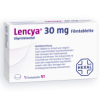
What is Finasteride and how does it work?

- What finasteride is and what it is licensed for in the UK
- How it works to slow and reverse hair loss
- How long it takes to produce results
- Whether topical finasteride works and how it compares
- Whether finasteride works on the hairline
- How to access finasteride in the UK
- What is finasteride?
- How does finasteride work for hair loss?
- Does finasteride work? What does the evidence show?
- How long does finasteride take to work?
- Does topical finasteride work?
- Does finasteride work on the hairline?
- What is the difference between finasteride 1mg and 5mg for hair loss?
- Who is finasteride suitable for?
- What forms of finasteride are available in the UK?
- How do you access finasteride in the UK?
- Final thoughts
What is Finasteride?
Finasteride is a prescription-only medicine licensed by the MHRA for two uses in the UK. At the 1 mg dose, sold under the brand name Propecia, it is used to treat male pattern hair loss. At the 5 mg dose, sold as Proscar, it is used to treat benign prostatic hyperplasia (BPH), a condition where the prostate gland becomes enlarged. Generic finasteride is available at both doses from GPhC-registered UK pharmacies. For a full comparison of branded Propecia and generic finasteride, see our Finasteride vs Propecia guide.
Finasteride is not licensed for use in women and must not be taken by women who are pregnant or may become pregnant. Pregnant women should not handle crushed or broken finasteride tablets due to the risk of absorption through the skin.
Good to know
Finasteride 1 mg is prescription-only in the UK and cannot be purchased without a valid prescription from a UK-registered prescriber, either via a GP or a regulated online clinic.
How does finasteride work for hair loss?
Finasteride belongs to a class of medicines called 5-alpha reductase inhibitors. It works by blocking the enzyme that converts testosterone into another hormone called dihydrotestosterone (DHT).
DHT is the primary driver of male pattern hair loss. In men who are genetically susceptible, DHT binds to hair follicles on the scalp and causes them to gradually shrink, producing thinner and shorter hairs over time until the follicle eventually stops producing hair altogether.
By reducing scalp and serum DHT levels by approximately 60 to 70%, finasteride slows or halts this process. In follicles that have not yet been permanently lost, the reduction in DHT can allow partial recovery and visible regrowth over time.
The most reliable outcome is stabilisation of hair loss. Regrowth, where it occurs, varies between individuals.
Does finasteride work? What does the evidence show?
Yes, for most men with androgenetic alopecia. The evidence base is among the strongest of any hair loss treatment.
The pivotal clinical trials submitted for MHRA approval showed that in men with mild to moderate androgenetic alopecia:
- 86% of men on finasteride 1 mg maintained or increased their hair count after one year, compared to 42% on placebo
- In two year-long studies, men on finasteride showed a mean increase of 107 hairs in a defined scalp area, compared to a decrease of 150 hairs in the placebo group
- Hair count improvements continued through year two before plateauing
Long-term data from five-year extension studies confirms that continued treatment maintains results, while discontinuation leads to resumption of hair loss within twelve months. For a detailed breakdown of what results look like at each stage of treatment, see our Finasteride before and after guide.
How long does finasteride take to work?
| Timepoint | What typically happens |
|---|---|
| 0–3 months | Possible increased shedding; no visible improvement |
| 3–6 months | Shedding stabilises; early density improvements in some men |
| 6–12 months | Most meaningful changes visible; regrowth apparent in responsive patients |
| 1–2 years | Continued improvement; plateau typically reached around 24 months |
| Beyond 2 years | Maintenance of achieved results with continued treatment |
The twelve-month mark is the most clinically meaningful assessment point. Discontinuing treatment before this point, particularly in response to early shedding, risks abandoning treatment before results can be properly evaluated.
Good to know
Early shedding in the first two to three months is a recognised and normal response to finasteride. It reflects hair cycle resetting as DHT levels fall and does not predict a poor outcome.
Does topical finasteride work?
Topical finasteride, applied directly to the scalp rather than taken orally, has an emerging evidence base that is generating significant interest. Because it is applied directly to the scalp rather than swallowed as a tablet, much less of the medicine enters the bloodstream. This means that DHT levels in the rest of the body are reduced to a lesser degree, while DHT levels in the scalp are reduced by a comparable amount to the oral version.
Early studies suggest that topical finasteride produces comparable improvements in hair density to oral finasteride, with a potentially lower incidence of systemic side effects due to reduced DHT suppression in non-scalp tissues. A study found topical finasteride produced significant hair count improvements compared to placebo over six months.
However, the evidence base for topical finasteride is less mature than for the oral form. Topical formulations are not currently MHRA-licensed as standalone products in the UK and are typically prescribed as specially prepared formulations under a prescriber's clinical judgement. For men concerned about the systemic side effects of oral finasteride, topical formulations are worth discussing with a prescriber, with the understanding that the evidence is still developing.
Does finasteride work on the hairline?
Finasteride works best for hair loss at the top (crown) and middle of the head. Regrowing hair at the frontal hairline is hardest to achieve.
Frontal scalp follicles are highly sensitive to DHT and often suffer advanced, irreversible shrinking before treatment even starts. As a result, clinical trials consistently show that hair regrowth is much stronger at the vertex (the top of the head) than at the front.
Stopping further hairline recession is a realistic and valuable goal. However, significantly regrowing hair that is already gone from the corners is unlikely, especially if the recession is already advanced. For men focused specifically on the hairline, combining finasteride with minoxidil is often more effective, as minoxidil offers complementary benefits for the front of the scalp.
What is the difference between finasteride 1mg and 5mg for hair loss?
Finasteride 1 mg is the dose licensed for male pattern hair loss. It reduces serum DHT by approximately 60 to 70%, which is sufficient to produce the hair retention and regrowth outcomes described in clinical trials.
Finasteride 5 mg is licensed for BPH and produces a greater reduction in serum DHT. It is not licensed for hair loss at this dose and is not recommended for this purpose, as the additional DHT suppression does not appear to produce proportionally greater hair benefits, though it does carry a higher side effect burden.
For hair loss, 1 mg is the evidence-supported dose. Using 5 mg for hair loss would represent off-label use and should only be considered under direct prescriber guidance.
Who is finasteride suitable for?
Finasteride 1 mg is suitable for adult men with androgenetic alopecia who wish to slow or reverse hair loss progression. It is most effective in men at earlier stages of hair loss (Norwood scale I to III) where more follicles remain viable, and in men who start treatment earlier in the progression of their hair loss.
Warning !
Finasteride is not licensed for use in women and is contraindicated in pregnancy. It is not suitable for men with a history of hypersensitivity to finasteride, and caution is required in men with liver disease. A full clinical assessment by a registered prescriber is required before starting treatment. For a full overview of finasteride's safety profile, see our guide to finasteride side effects
What forms of finasteride are available in the UK?
- Oral tablets (1 mg): The standard licensed form for hair loss; available as branded Propecia and generic finasteride from GPhC-registered UK pharmacies on prescription
- Oral tablets (5 mg): Licensed for BPH; available as branded Proscar and generic finasteride on prescription
- Topical formulations: Available from some regulated UK private prescribers as specially prepared solutions, often combined with minoxidil; not currently MHRA-licensed as standalone products
How do you access finasteride in the UK?
Finasteride is prescription-only and requires a clinical assessment by a UK-registered prescriber. Legitimate access routes include a GP (NHS or private) or a regulated online clinic.
DoktorABC connects UK patients with licensed prescribers who can assess suitability for finasteride and issue private prescriptions where clinically appropriate. Always verify that any online service is CQC-registered and uses a GPhC-registered pharmacy before proceeding.
Final thoughts
Finasteride is the most evidence-based oral treatment for male pattern hair loss available in the UK. For most men who start treatment early and use it consistently, it stabilises hair loss and produces meaningful improvement in hair density over twelve to twenty-four months. Results require ongoing treatment to maintain, and realistic expectations from the outset make for a better treatment experience.
FAQ
Does finasteride work?
Yes, for most men with androgenetic alopecia. 86% of men in clinical trials maintained or increased hair count after one year.
How long does finasteride take to work?
Visible results are typically apparent by six to twelve months. The twelve-month mark is the most meaningful assessment point.
Does topical finasteride work?
Early evidence is promising, with comparable scalp efficacy to oral finasteride and potentially fewer systemic side effects. The evidence base is still developing.
Does finasteride work on the hairline?
Finasteride's strongest evidence is for the crown and mid-scalp. Frontal hairline regrowth is less predictable; stabilisation is a more realistic expectation.
What is the difference between finasteride 1mg and 5mg?
1 mg is the licensed hair loss dose. 5 mg is licensed for BPH and carries a higher side effect burden without proportionally greater hair benefits.
Is finasteride suitable for women?
No. Finasteride is not licensed for use in women and is contraindicated in pregnancy.
How do I get finasteride in the UK?
Via a GP prescription (NHS or private) or a regulated online clinic. Always verify GPhC and CQC registration before using any online service.
The DoktorABC medical advisory board

Dr. Roland Ruiken
Medical advisor, Norway

Dr. Viktor Simunovic
Medical advisor, Croatia