












How much GLP-1 should you take for weight loss?

- Why dose and product are never chosen or changed without a prescriber
- What "GLP-1" means, and how licensed products differ
- Why doses start low and rise gradually
- Current UK dosing for each licensed product
- Why tablets and unlicensed drops are not interchangeable
- What to do about a missed or extra dose
- When a dose increase may pause, and what is urgent
- What ongoing monitoring involves
- Follow your prescription, not a general guide
- What does "GLP-1" actually mean?
- Why do GLP-1 doses start low and increase gradually?
- What are the current UK doses for each product?
- Are GLP-1 oral liquids or drops the same as licensed tablets?
- What should you do about a missed, delayed, or extra dose?
- What could delay your next dose increase?
- What monitoring happens during treatment?
- Final thoughts
Follow your prescription, not a general guide
No one should choose their own dose, split a tablet, count pen clicks for a partial dose, combine products for a different strength, or change a dose because results feel slow. Use only the exact pen or tablet named on the prescription, following its patient information leaflet (PIL).
Warning!
Never select, adjust, split, or combine a GLP-1 dose yourself. If a dose feels wrong, contact the prescriber or a pharmacist.
What does "GLP-1" actually mean?
GLP-1 stands for glucagon-like peptide-1, a hormone made naturally in the gut. It is not a brand or a single medicine. Medicines that copy its effects are called GLP-1 receptor agonists, and some newer ones also act on a second hormone, GIP, making them dual GIP/GLP-1 receptor agonists.
The same active ingredient can also appear in more than one brand, at different doses, for different purposes. Semaglutide is one example: it is licensed as Ozempic for type 2 diabetes and as Wegovy for weight management, each at its own dose. Sharing an active ingredient does not mean two brands share a dose.
Why do GLP-1 doses start low and increase gradually?
Licensed GLP-1 and GIP/GLP-1 weight-management medicines start low and increase in steps over weeks or months. This titration lets the gut adjust and reduces side effects like nausea, vomiting, or diarrhoea.
A higher dose is not automatically better. Many people reach meaningful, sustained weight loss on a lower maintenance dose, with no need to reach the highest licensed strength.
Good to know
Staying on a lower maintenance dose than the maximum licensed dose is a recognised, often appropriate outcome, not a sign of failed treatment.
What are the current UK doses for each product?
Figures below are from the current UK SmPC or PIL for each product. Injectable and oral doses of the same active ingredient are not interchangeable.
| Active ingredient | Brand | Form | Frequency | Starting dose | Escalation | Maintenance dose(s) | Maximum dose |
|---|---|---|---|---|---|---|---|
| Semaglutide | Wegovy (injection) | Injection | Weekly | 0.25 mg | Every 4 weeks: 0.5, 1, 1.7, 2.4 mg | 2.4 mg (7.2 mg optional) | 7.2 mg |
| Semaglutide | Wegovy Pill | Oral | Daily | 1.5 mg | Min. 1 month/step: 4, 9 mg | 25 mg | 25 mg |
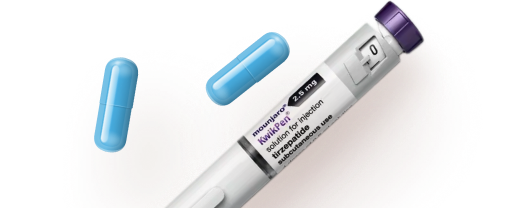
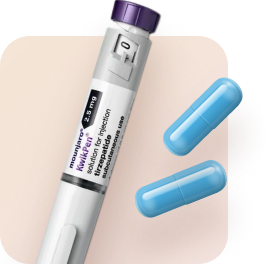
| Tirzepatide | Mounjaro | Injection | Weekly | 2.5 mg | Min. 4 weeks/step, 2.5 mg rises | 5–15 mg, individualised | 15 mg |
| Liraglutide | Saxenda | Injection | Daily | 0.6 mg | Weekly, 0.6 mg rises | 3.0 mg | 3.0 mg |
| Orforglipron | Foundayo | Oral | Daily | 0.8 mg | Min. 30 days/step: 2.5, 5.5 mg | 9, 14.5 or 17.2 mg | 17.2 mg (9 mg if on certain interacting medicines) |
Your prescriber will confirm the exact schedule and the maintenance dose that suits you, adjusting the pace if side effects call for it. Use this table to understand the shape of treatment before that conversation, not as a substitute for the PIL that comes with your specific medicine.
Are GLP-1 oral liquids or drops the same as licensed tablets?
No. The oral GLP-1 medicines currently licensed in the UK for weight management (the Wegovy Pill and Foundayo) are film-coated tablets dosed as shown above. Products marketed as "GLP-1 oral liquid" or "GLP-1 drops" are not licensed UK weight-management medicines.
Dose units and absorption differ by formulation. An injection dose cannot be converted to a tablet dose, and there is no reliable way to convert a licensed dose into a liquid or drops product sold outside the licensed supply chain. Such products, sold without a valid UK prescription and MHRA authorisation, should not be used.
Warning!
The MHRA has warned that medicines bought without a prescription from unregulated sellers may be counterfeit, incorrectly dosed, or contaminated. Report suspected unlicensed or counterfeit products via the Yellow Card scheme.
What should you do about a missed, delayed, or extra dose?
Guidance differs by product and is set out in its PIL. Never take two doses together to make up for one missed, and never combine different products to compensate. Contact the prescriber or pharmacist for product-specific advice rather than guessing.
What could delay your next dose increase?
Your next dose increase may be paused if you have troublesome nausea, vomiting, or diarrhoea, if you're not eating or drinking enough, if your other medicines change, or if you've had a break from treatment. Your prescriber may keep you on your current dose for longer, lower it, or advise stopping altogether.
Warning!
Seek urgent help via NHS 111, a pharmacist, or 999/A&E for severe or persistent abdominal pain, a severe allergic reaction, persistent vomiting, or dehydration. For a suspected significant overdose, contact NHS 111 or attend A&E, taking the packaging where possible.
What monitoring happens during treatment?
Ongoing treatment typically involves regular review of weight and progress, nutrition and hydration, side effects, blood glucose where relevant, other medicines, and agreed goals. These reviews, carried out with a prescriber, guide whether to increase, hold, or stop the dose.
Final thoughts
GLP-1 is not one medicine with one dose. It is a class of hormone-based treatments, and each one, whether an injection or a tablet, comes with its own starting dose, its own pace of increase, and its own maximum, set out in its UK SmPC and PIL. None of these figures are safe to estimate, swap between products, or apply to an unlicensed liquid or drops. DoktorABC connects you with a licensed UK prescriber who can assess whether GLP-1 or GIP/GLP-1 treatment is right for you and build a dosing plan around your response, with ongoing review along the way.
FAQ
Can I stay on a lower dose?
Yes, if it meets agreed goals and is well tolerated. Reaching the maximum licensed dose is not a requirement.
How long is each dose used before increasing?
This varies by product, from weekly steps to a minimum of one month, set by the SmPC and the prescriber.
Does body weight determine the dose?
No. Dosing follows a fixed titration schedule. Weight and BMI inform eligibility, not the milligram dose.
Can I switch between products?
Only under prescriber guidance, as doses are not directly interchangeable between active ingredients or formulations.
What if the pen still contains liquid when it's time for a new one?
Follow that pen's PIL. Never combine leftover medicine between pens; ask the prescriber or pharmacist if unsure.
Are online GLP-1 drops legitimate?
No licensed UK weight-management product is sold as a liquid or drops. Products marketed this way sit outside the licensed supply chain and should not be used.
The DoktorABC medical advisory board

Dr. Roland Ruiken
Medical advisor, Norway

Dr. Viktor Simunovic
Medical advisor, Croatia