













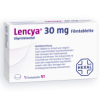
Minoxidil and beard growth: What to know before you try it

- How minoxidil may stimulate beard growth
- UK regulatory status: Why beard use is off-label and what that means
- Which formulations are used
- How to apply it correctly
- A realistic results timeline: What to expect at 3, 6, and 12 months
- Side effects specific to facial use and how it differs from scalp application
- When to stop or reassess
- How minoxidil may stimulate beard growth
- UK regulatory status: Off-label use explained
- What the clinical evidence shows
- Which formulations are used for beard growth
- How to apply minoxidil to the beard correctly
- What results to expect over time
- Managing expectations: before and after
- Side effects specific to beard and facial use
- When to stop or reassess
- Final thoughts
How minoxidil may stimulate beard growth
Minoxidil is a vasodilator and potassium channel opener. Applied topically, it increases blood flow to hair follicles, prolongs the active growth phase of the hair cycle (anagen), and in some cases, convert fine vellus hairs (the short, light hairs that make up sparse facial coverage) into thicker, darker terminal hairs over time.
The same mechanism that drives hair growth on the scalp applies to facial follicles. Beard follicles respond to minoxidil in a broadly similar way, though the evidence base for this use is considerably smaller than for scalp application.
Good to know
Minoxidil does not create new hair follicles. It works by stimulating existing follicles that are already present but may be producing fine, barely visible hair. If a facial area has no follicles at all, minoxidil is unlikely to produce growth there.
UK regulatory status: Off-label use explained
In the UK, topical minoxidil is licensed only for androgenetic alopecia of the scalp. Using it on the face is off-label, meaning it is being used outside the terms of its marketing authorisation.
Off-label prescribing is legal and common in UK medical practice, provided the clinician is satisfied the use is supported by evidence and in the patient's best interest. However, it means that the MHRA has not specifically reviewed or approved beard use, and the safety and efficacy data for this application is less comprehensive than for scalp use.
Important !
Because beard use is off-label, minoxidil is not formally recommended or prescribed for this purpose through standard NHS pathways. If you are considering using it for beard growth, it is worth discussing with a prescriber, particularly if you have any underlying health conditions.
What the clinical evidence shows
There are a multitude of informal reports on online communities presenting personal anecdotes regarding minoxidil's effectiveness as a facial hair enhancement tool. However, this has been seldom discussed in the literature, with one randomised trial showing minoxidil's efficacy for beard enhancement, and a handful of case reports discussing the matter.
The most cited study is a randomised, double-masked, placebo-controlled trial by Ingprasert et al. (2016), which enrolled 48 men desiring fuller facial hair coverage and found that topical minoxidil 3% lotion produced a statistically significant increase in beard density compared to placebo.
A 2024 case report described identical twin males where one applied 5% topical minoxidil daily for over a year to the beard and moustache area. After 16 months, the treated twin showed visibly greater beard hair count and density compared to both his untreated twin and his own baseline.
At the one-month mark, the treated twin noted the presence of new, finer, lighter-coloured hairs. By two months, a modest increase in facial hair density was observed. Shedding occurred at approximately three months, followed by continued progressive growth. After 16 months, a greater hair count and density in both the beard and moustache areas was clearly visible.
The evidence is promising but limited. The available research consists primarily of small trials and case reports rather than large-scale randomised controlled trials. Results vary between individuals, and minoxidil for beard growth should be approached with realistic expectations.
Which formulations are used for beard growth
Three topical formulations are commonly used for beard application, each with practical differences.
Minoxidil 5% solution: The most widely available and most studied formulation for both scalp and beard use. It contains alcohol, which can cause dryness and irritation on facial skin, particularly in men with sensitive skin.
Minoxidil 5% foam: Contains no propylene glycol or alcohol, making it gentler on the skin and better tolerated for facial application. The 5% foam, which lacks propylene glycol, has been associated with significantly reduced irritation and higher patient adherence. It is the most commonly recommended formulation for beard use among dermatologists.
Minoxidil spray: A variant of the solution in spray format. The active ingredient and concentration are the same as the solution, and the side effect profile is comparable. The spray format makes targeted application to specific facial areas straightforward.
Good to know
For facial use, the foam is generally preferred over the solution due to its lower irritation potential. The skin on the face is typically more sensitive than the scalp, and the alcohol content of the solution can cause noticeable dryness with regular use.
How to apply minoxidil to the beard correctly
Applying minoxidil to the beard follows similar principles to scalp application, with a few additional considerations for facial skin.
- Apply once daily, typically in the evening, to clean, dry facial skin
- Use approximately 1 ml of solution or half a capful of foam per application
- Apply directly to the areas of the beard where growth is sparse or absent, using fingertips to spread evenly
- Allow to dry completely before touching your face, going to bed, or applying any other products
- Wash hands thoroughly after application
- Do not apply to broken, irritated, or sunburned skin
Important !
Allow minoxidil to dry completely before any skin-to-skin contact with others, particularly partners or children. The medicine can be transferred through contact with wet or recently applied products.
What results to expect over time
Results with minoxidil build gradually rather than appearing quickly. The table below sets out a realistic timeline based on the available clinical evidence and case reports, though individual progress will vary.
| Timeframe | What typically happens |
|---|---|
| Month 1 | Fine, lighter-coloured hairs may begin to appear in previously sparse areas |
| Month 2 to 3 | Modest increase in density; possible shedding phase as follicles transition |
| Month 3 to 6 | Continued growth; fine vellus hairs begin converting to thicker terminal hairs in some men |
| Month 6 to 12 | More noticeable improvement in density and coverage for consistent users |
| Beyond 12 months | Further maturation of terminal hairs; some hairs established over 12 months may persist after stopping |
The shedding that sometimes occurs around months two to three is a recognised part of the process, reflecting follicles cycling through the resting phase before entering active growth. It is not a sign that the treatment is not working.
Good to know
Terminal hairs that have been fully established for 12 months or more often remain permanent once matured, as they no longer rely on minoxidil to survive. This suggests that long-term consistent use may produce some lasting benefit even after stopping, though this is not guaranteed for all men.
Managing expectations: before and after
The published evidence and patient experience consistently show that results vary considerably between individuals. Some men see meaningful improvement in density and coverage within six months; others see modest change or none at all.
What minoxidil can realistically do for beard growth in men with existing follicles is:
- Increase the density and thickness of existing hair
- Accelerate the conversion of vellus to terminal hairs in some areas
- Improve coverage in patchy regions
What it cannot do is:
- Generate growth in areas where follicles are entirely absent
- Produce results equivalent to surgical beard transplantation
The difference between a good and a poor responder is not always predictable in advance. Age, genetics, baseline follicle density, and consistency of application all influence outcomes. A minimum commitment of six months of consistent daily use is needed before drawing conclusions about effectiveness.
Side effects specific to beard and facial use
The side effect profile for facial minoxidil overlaps with scalp use but has some additional considerations.
Skin dryness and irritation: More common on facial skin than the scalp, particularly with the alcohol-based solution. Switching to the foam formulation and using a gentle moisturiser on surrounding skin reduces this significantly.
Facial skin absorption: The face has a higher absorption rate than the scalp in some areas, meaning slightly more minoxidil may enter the bloodstream with facial application than scalp application. At the concentrations used, this is unlikely to be clinically significant for most healthy men, but is worth noting for those with cardiovascular conditions.
Spread beyond the intended area: Applying minoxidil to the face increases the risk of inadvertent contact with other facial skin areas, potentially causing hair growth in unintended locations. Careful application and thorough handwashing after each use mitigates this.
Initial shedding: As described above, a temporary shedding phase is common around months two to three and is not a cause for concern.
Important !
If you experience significant skin irritation, redness, swelling, or any cardiovascular symptoms such as palpitations or dizziness while using minoxidil on the face, stop using the product and contact your GP.
When to stop or reassess
Consider stopping or discussing with a prescriber if:
- Skin irritation is persistent and not resolved by switching to the foam formulation
- You have seen no change after six months of consistent daily use
- You experience any cardiovascular symptoms including palpitations, dizziness, or swelling
- You are planning to try to conceive: while topical minoxidil has limited systemic absorption, the implications for fertility have not been extensively studied
Final thoughts
Minoxidil for beard growth is off-label, and the evidence is promising but not yet extensive. For men with existing follicles who want to improve beard density, consistent daily use over at least six months is needed to assess whether they are likely to respond. Results vary, and there is no reliable way to predict in advance how well an individual will respond.
If you have questions about whether minoxidil is appropriate for you, or want to discuss your options with a UK-registered prescriber.
FAQ
Does minoxidil work for beard growth?
The available clinical evidence suggests it may help improve beard density in some men, but the evidence base is limited and results vary considerably between individuals. It is not licensed for this use in the UK and should be approached with realistic expectations.
How long does minoxidil take to work on a beard?
Most men who respond begin to notice fine new hairs within one to two months. More meaningful improvement in density and thickness typically requires six to twelve months of consistent daily use.
Which minoxidil is best for beard growth?
The 5% foam is generally preferred for facial use due to its lower irritation potential compared to the alcohol-based solution. Both are used in practice and the evidence does not clearly favour one formulation over the other for efficacy.
Do I need a prescription for minoxidil for beard growth?
Topical minoxidil 5% solution and foam are available over the counter in the UK. However, because beard use is off-label, discussing it with a prescriber before starting is advisable, particularly if you have any underlying health conditions.
Will beard growth continue after stopping minoxidil?
Some terminal hairs established over more than 12 months of use may persist after stopping. However, for most men, stopping minoxidil will lead to a gradual reversal of any growth gains over several months.
The DoktorABC medical advisory board

Dr. Roland Ruiken
Medical advisor, Norway

Dr. Viktor Simunovic
Medical advisor, Croatia